Hello. My name is Tom O’Neill. I am a Jesuit priest and painter currently living in Los Angeles. This blog is a way for me to share some of my paintings. My friends tease me because, aside from my MFA show back in 2002, I rarely show any of my work.
This blog is an attempt to change that. So, here are images of my pilgrimage in paint.
In 2005, my Jesuit superiors became concerned about my drinking. I was sent to a treatment center in St. Louis for an evaluation of my relationship with alcohol. Just about every fiber of my being resisted what felt like an unwelcome intrusion into my private life. There was a signifiant amount of turbulence as my flight began its descent into the airport in St. Louis. I remember thinking to myself, “Tom, these planes were built for this.” And, “Tom, you are built for what awaits you.”
My solution was simple: I lied my way through the entire evaluation. Looking back on it, I am actually a bit horrified at how easily — and successful — I was at dancing around what were, as it turned out, the serious and significant issues I had with booze.
The whole adventure, meetings with doctors, therapists, and a priest who was supposed to evaluate my spiritual maturity after a 40 minute chat…all of it resulted in a lengthy report that was forwarded to my superiors — and a copy to me. While it was determined that I need not stay for treatment (I guess I lied really well) the report was about 30 pages of observations and suggestions as to how I should live my life.
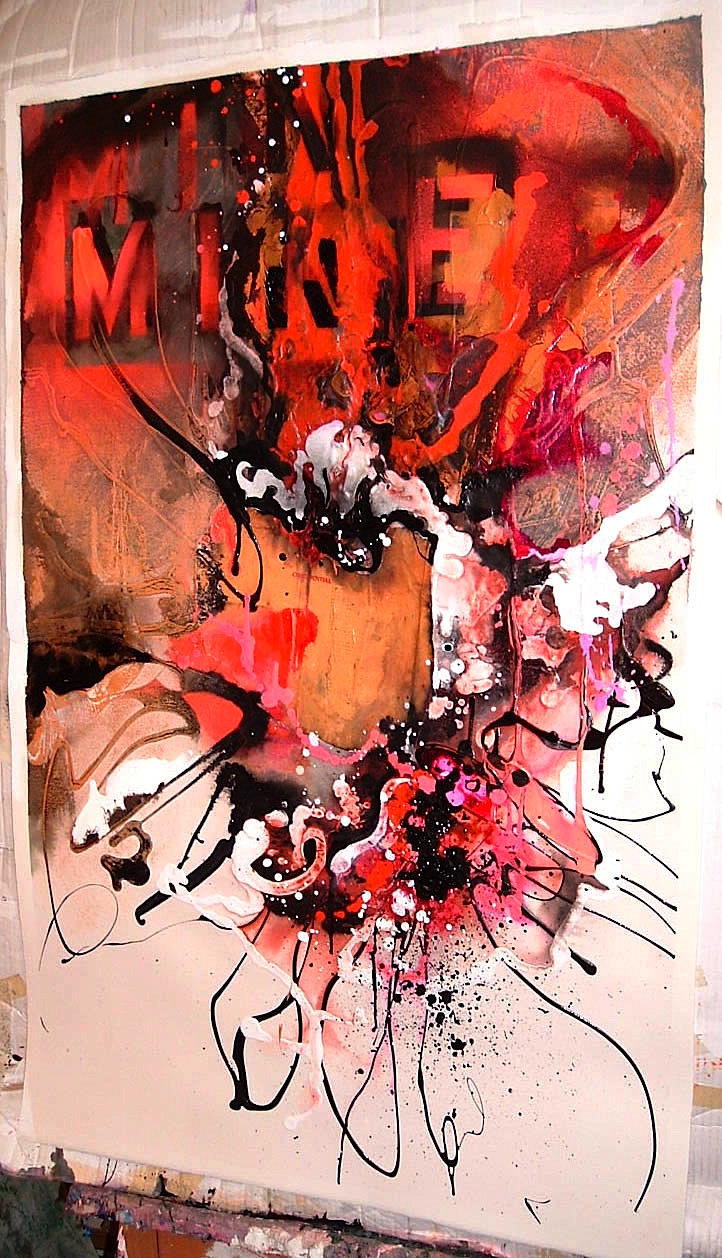
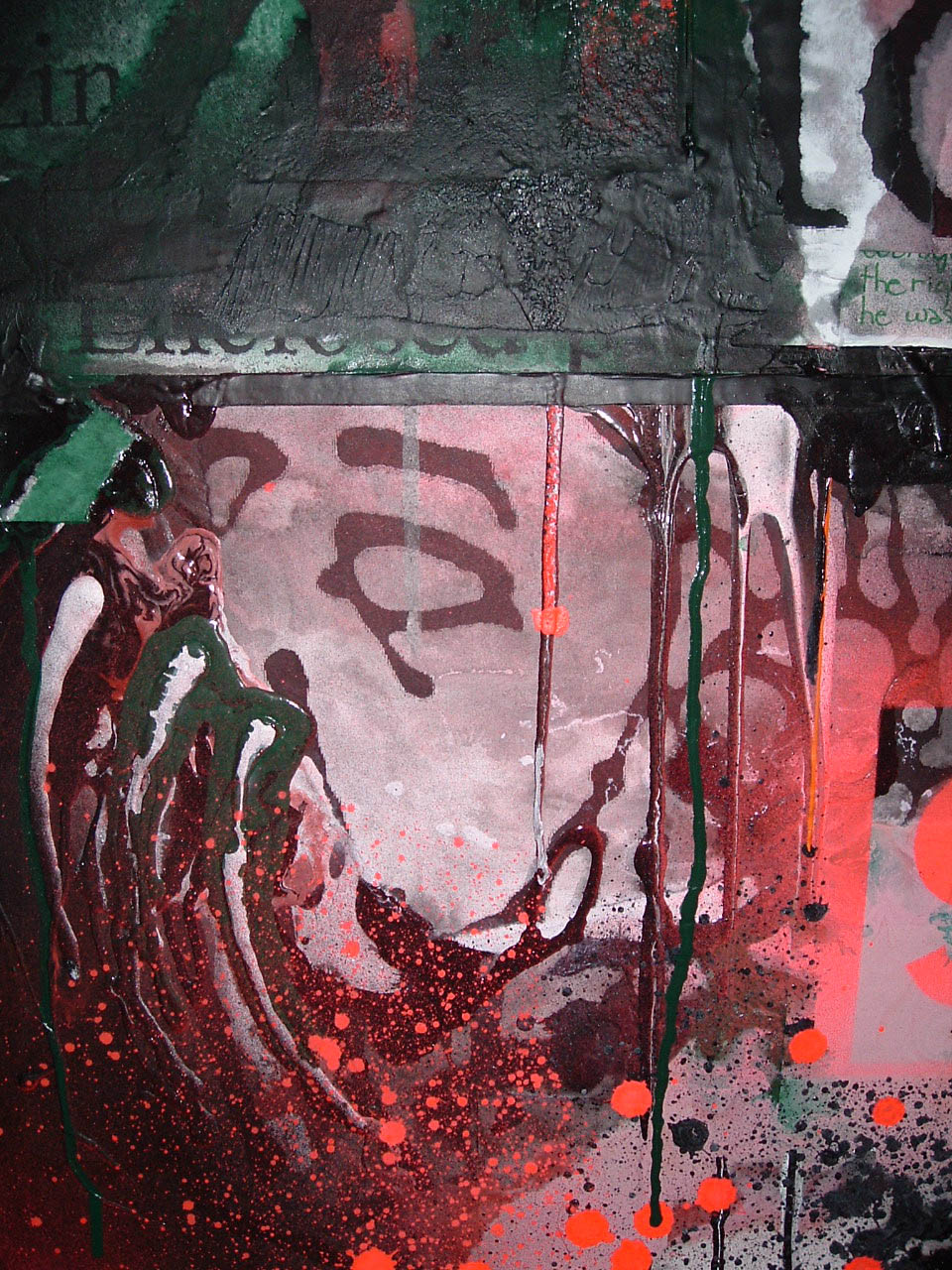
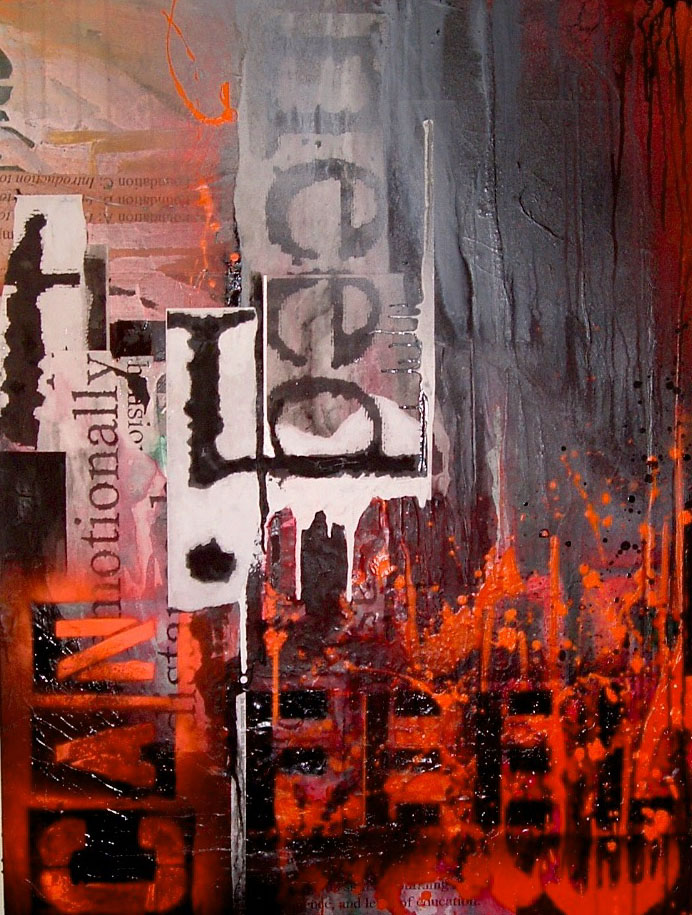
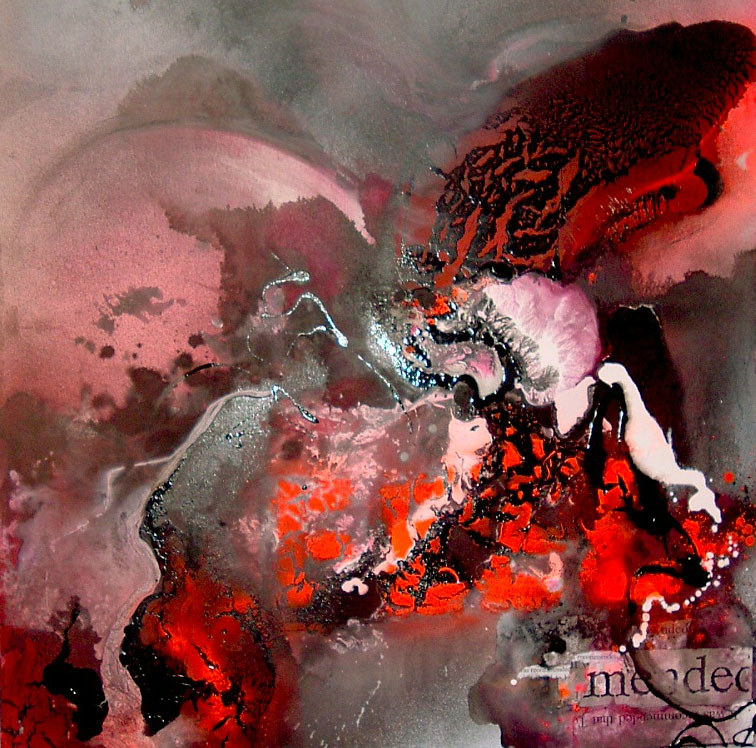
I never read it. When it appeared in my mailbox in a large manila envelope, I tore it apart — and with the help of a Xerox machine that enlarged the text — I began to collage fragments of the dissembled report into a series of very angry paintings. Using white gesso, black enamel and red, orange and pink fluorescent spray paint, I fashioned my own evaluation of the evaluation.
The good news was that people who saw these paintings were moved by their graphic honesty and emotion. The bad news was that it took another nine years for me to get sober.
This was the first in the series. In the center of this large piece of watercolor paper is the manila envelope in which the report was sent. The word “Confidential” is stamped in red. Looking at it now, the white gesso and black enamel form a ghostly shape that is trying to claw back the report into my own possession. The splattered paint seems to have almost been spit upon the surface — and indication of my feelings about the whole experience. And if that wasn’t clear enough, the stenciled word, “MINE” not so subtly expressed my response to all of the questions and queries that had been made about my use and abuse of alcohol.
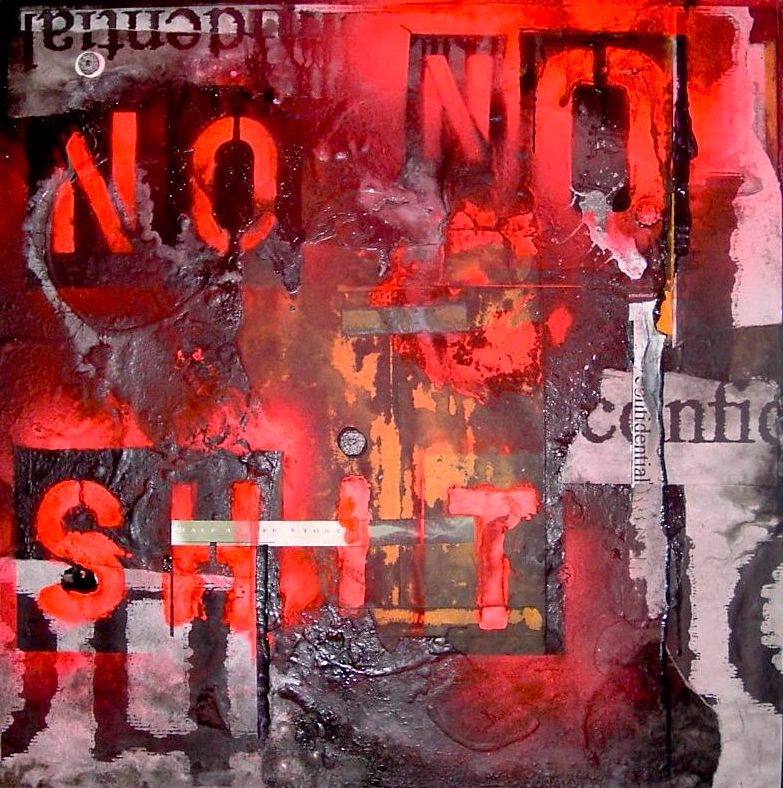
The other half of the manila envelope appears in this next painting, a 24-inch square canvas:
Again, I highlight the word “Confidential” — coped and enlarged over and over — and in dialogue with a (once again) not too subtle red fluorescent comment how I experienced confidentiality throughout the whole experience in St. Louis. Two additional elements to note: I added a couple of eucalyptus acorns (old friends that I had used in earlier, happier paintings) and part of the cover of a book, Becoming a Man: Half a Life Story, by Paul Monette. My brother Joe had sent me this book a few years before and Monette’s story had a huge impact on my life. While I don’t think I considered it at the time I made this piece, much of what I was seeking to protect throughout this experience — vulnerable, tender and honest parts of myself — were beautifully expressed in his “half a life story.”
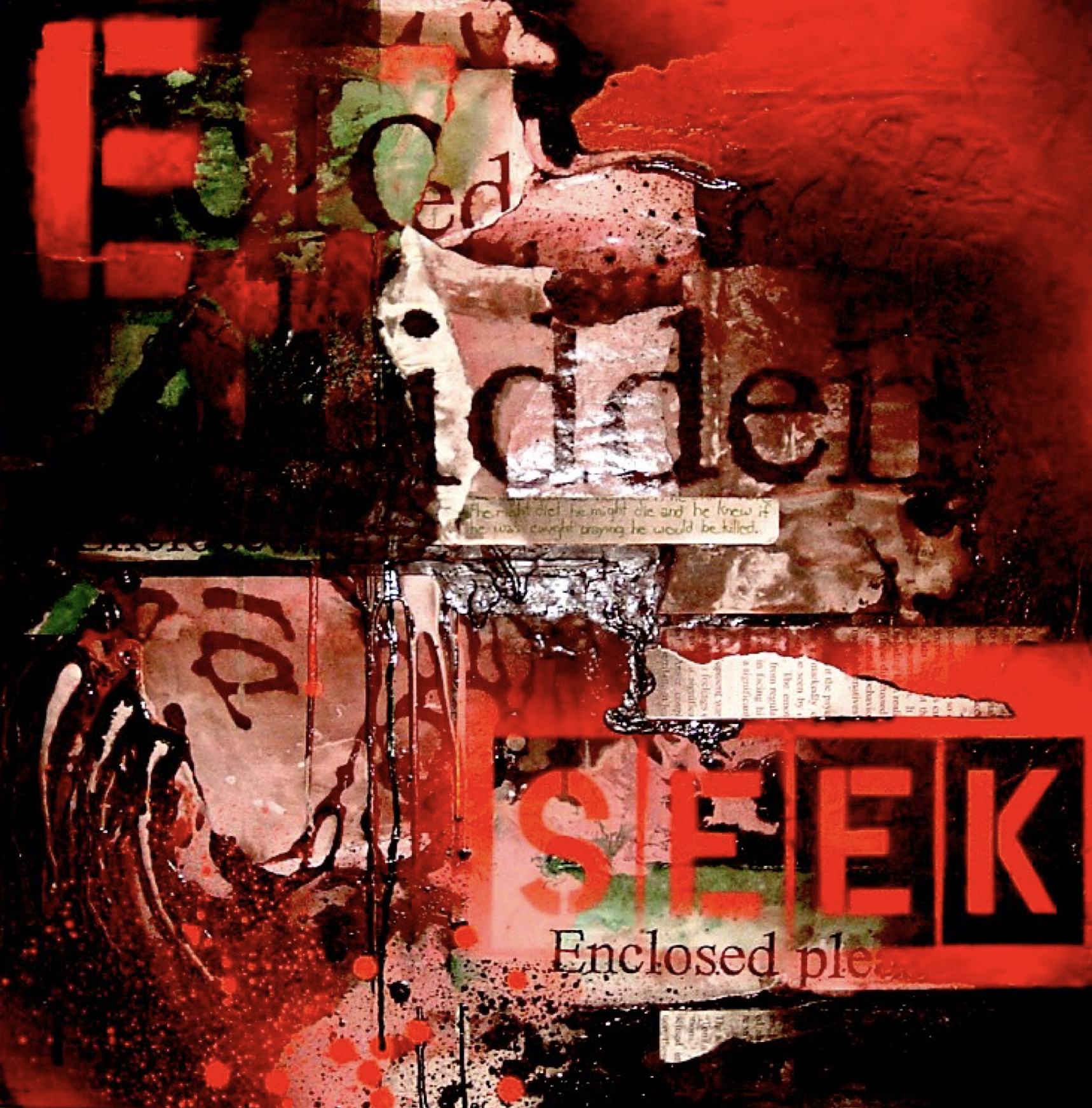
Another 24-inch square painting done around the same time, sadly, no longer exists. It was destroyed in a fire several years ago. I am grateful to have a photo of it, even if the quality is rather poor.
Here, I used the copied and enlarged text from the report, gesso, enamel and spray paint along with an enlarged image of a face copied from a medieval manuscript. The face is being “hushed” by a hand made up of gesso and enamel. In the center is a small piece torn from a 6th grade religion project. A tender Tommy, way back then, had been given an assignment to create a little booklet about the Prophets of the Old Testament. A fragment from that grammar school report, written in green marker on binder paper is placed at the very center of this painting. It reads, “…he knew if he were caught praying he would be killed.” Some forty years later that is exactly I how felt sitting in the waiting room in the treatment center before my first interview.
The advice that Ross Neher gave me about taming and corralling my prodigal use of materials (“Why do you glue this sh*t to the canvas”) eventually helped me quiet my use of color. Sometimes the power of color (or truth) isn’t about how loud it is, but how carefully it is used.
These are the paintings that made up my M.F.A. Exhibition in April of 2002.
Both Untitled; 2′ x 2′
The rest are also Untitled; 3′ x 3′
I also include the Thesis Statement that was part of the Exhibition
Moving back to Los Angeles after 24 years, I’ve reconnected with friends and family — which is something that I expected would happen. What I didn’t suspect — or what I had forgotten — is that I’d given away paintings to these folks many years ago. Seeing them again, was like seeing old friends. All of them were painted back in the 1980’s or early 1990’s (I think).
A Crucifixion, probably from the early 1980’s.
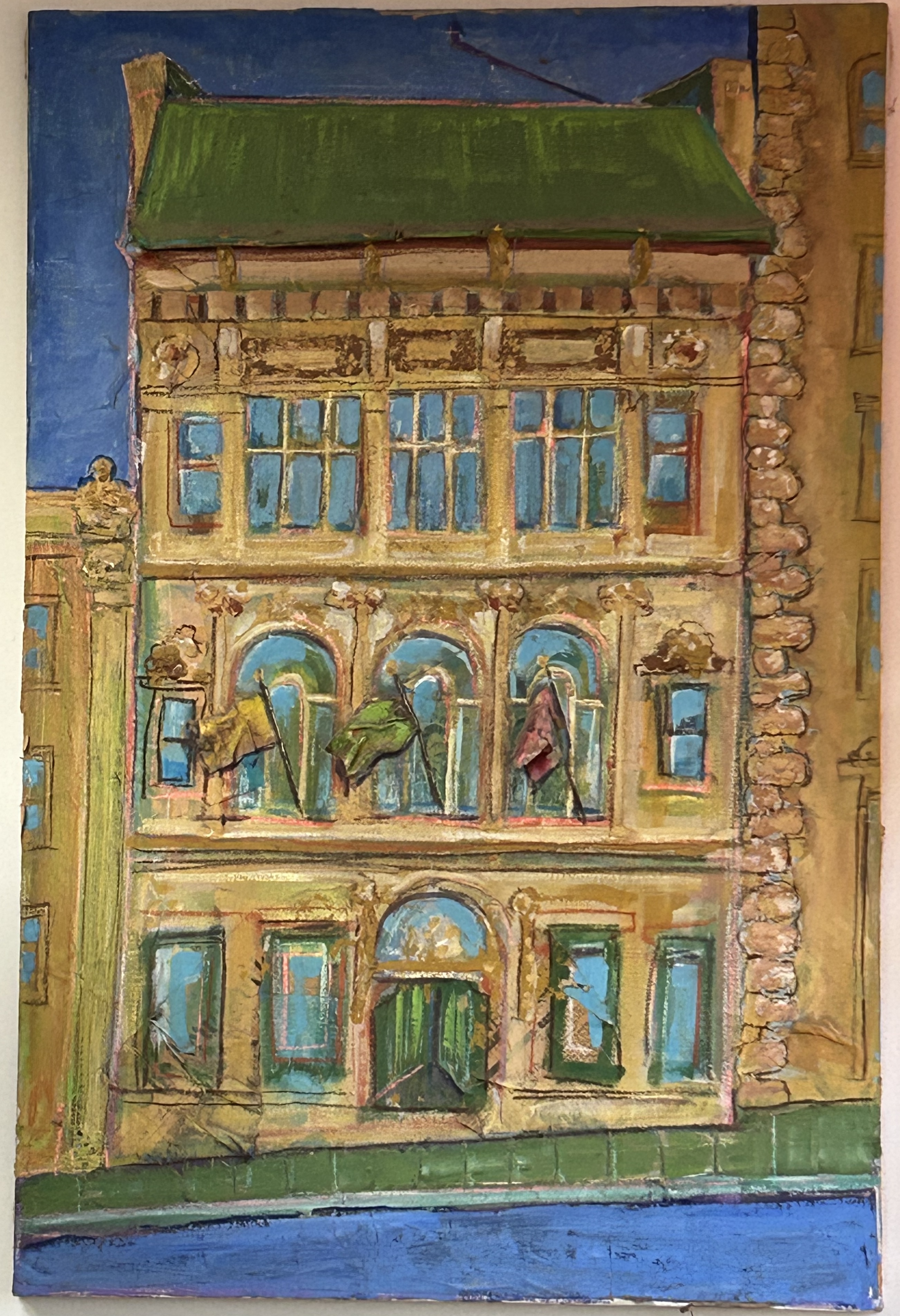
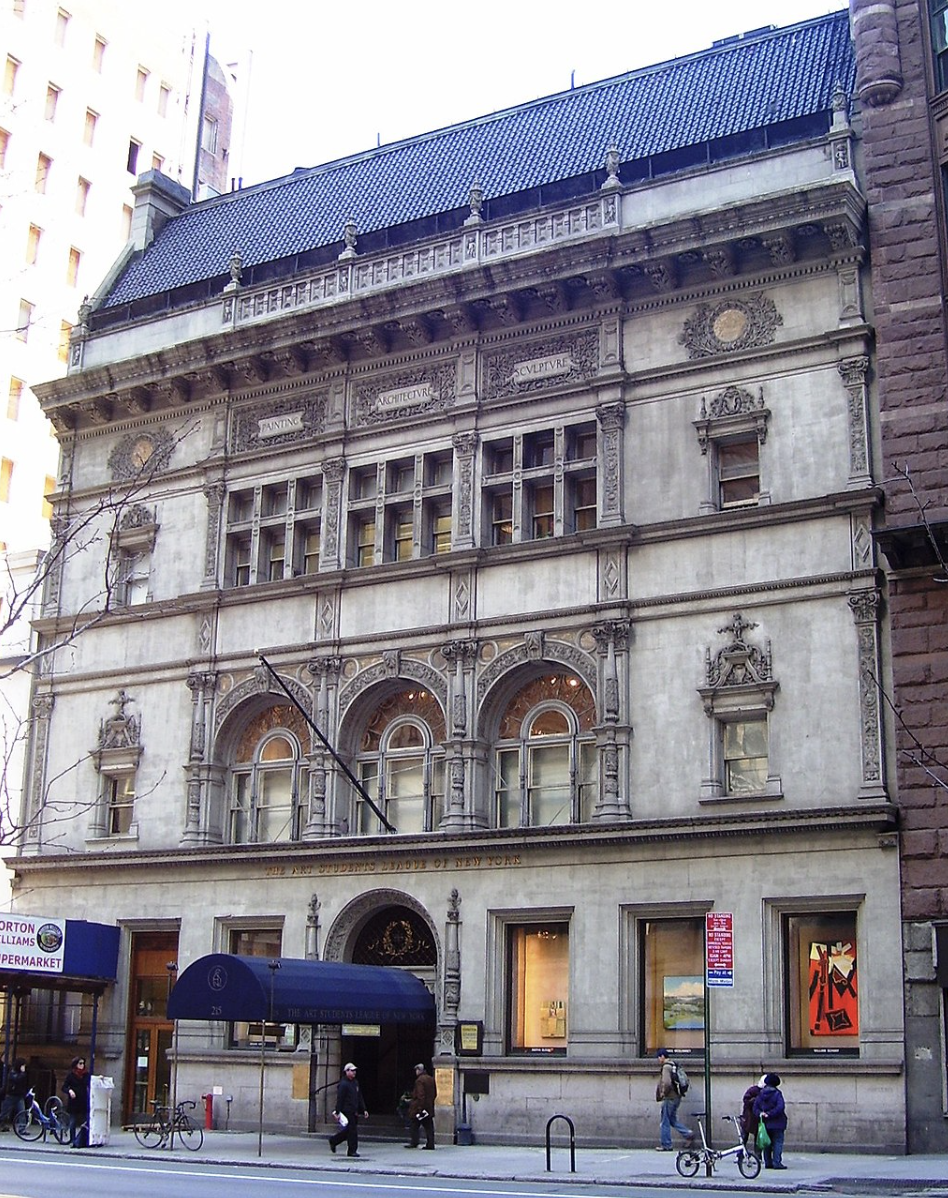
Again, from the 1980’s — a mixed-media work of “The Art Student’s League” in New York City. I took some painting classes there in the Spring of 1982. The whole place smelled of oil paint. Heaven. I think I made this painting when I was taking undergraduate art courses at L.M.U.
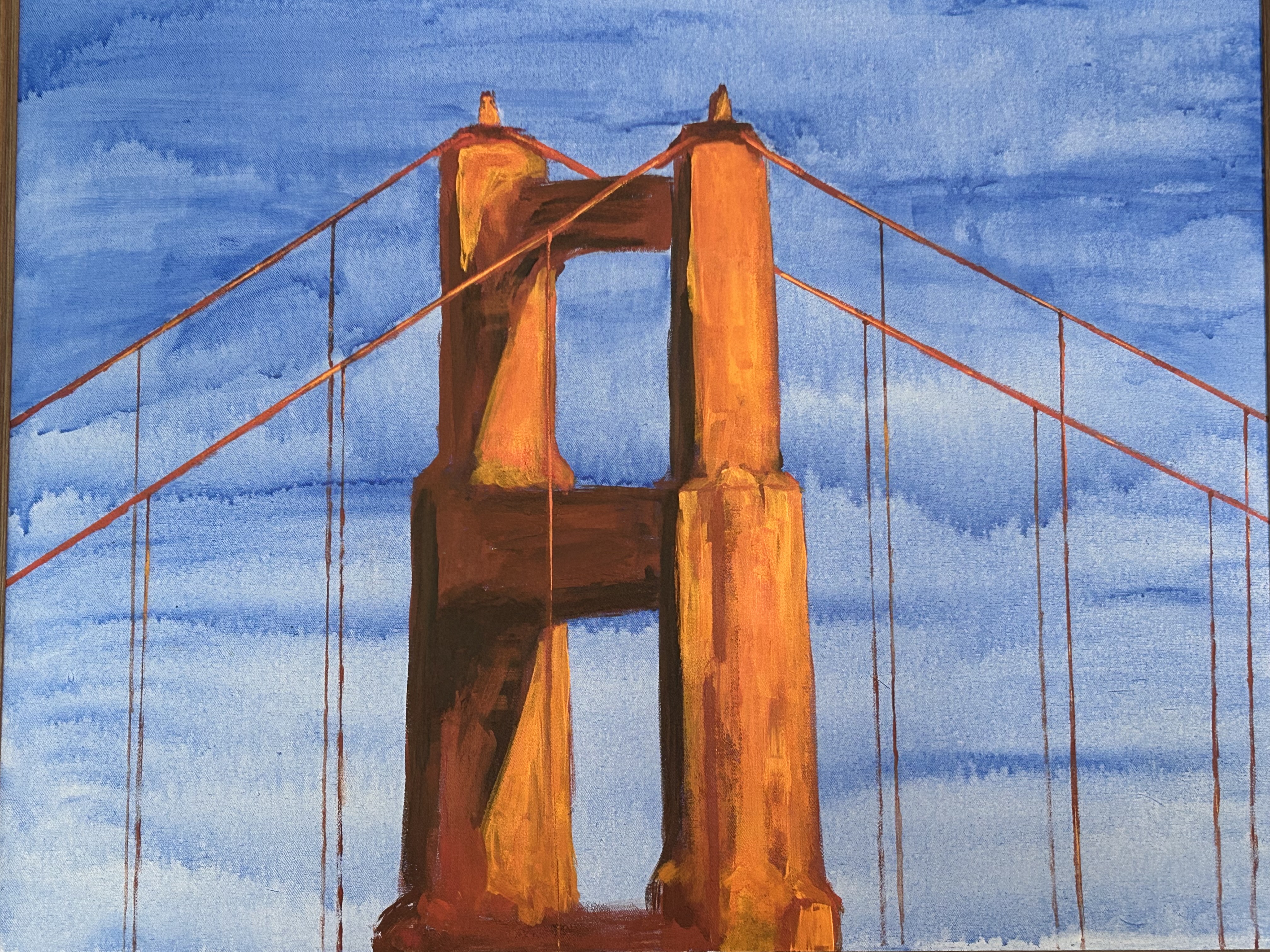
A painting of New York City that I gave to my cousin Tom Henry. Seeing it again was bittersweet. I painted this shortly after my first time living in New York from 1980 to 1982. The second time I lived in New York (2000 to 2002,) I watched those two Towers fall.
My hometown. You see, I can paint without splatters.
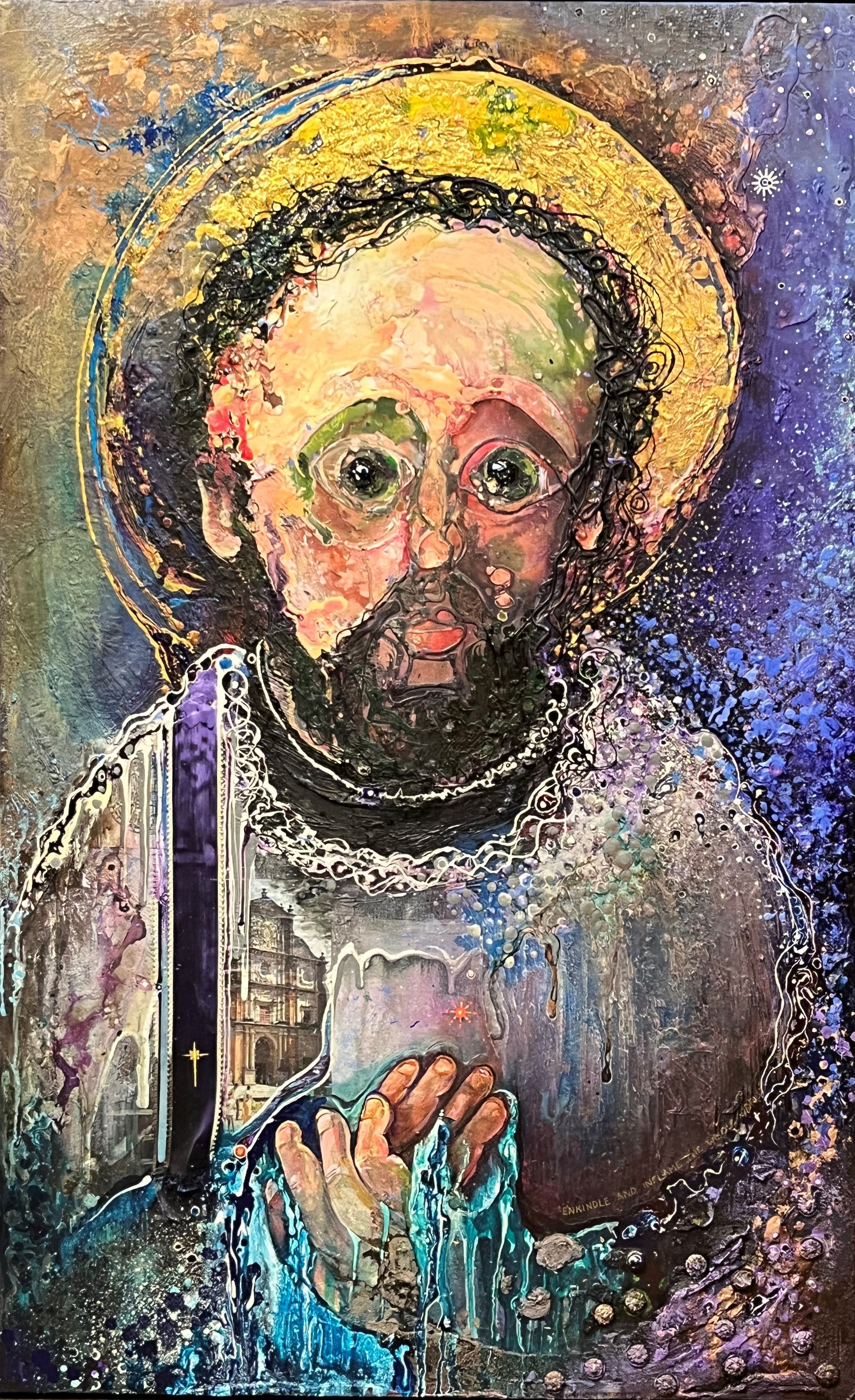
Finally, and this is from 1999. Someone in the L.M.U. Jesuit Community asked me do a painting of St. Francis Xavier. (Xavier was the name of the Jesuit residence at the time.) One of the Jesuits who lives there today was kind enough to send me a photograph of it. I remember not really liking it when I made it. I like it a little better now. I was beginning my love affair with drips, dribbles and splatters.
Working with the pita bread as a stencil — or a tool — rather than an object collaged onto the canvas opened up a door and helped me find a path. I simplified my use of color. Things calmed down. And I found my voice.
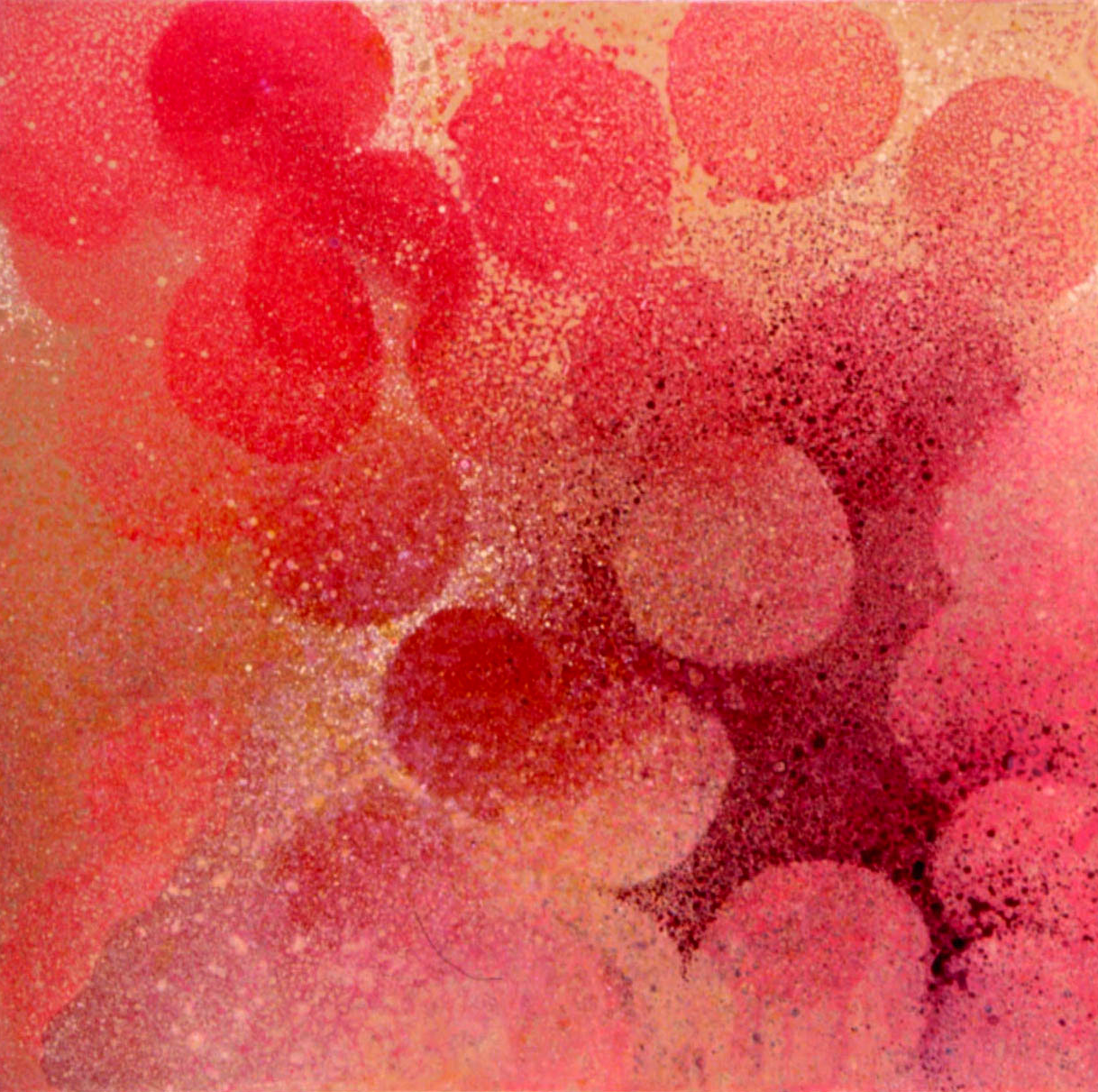
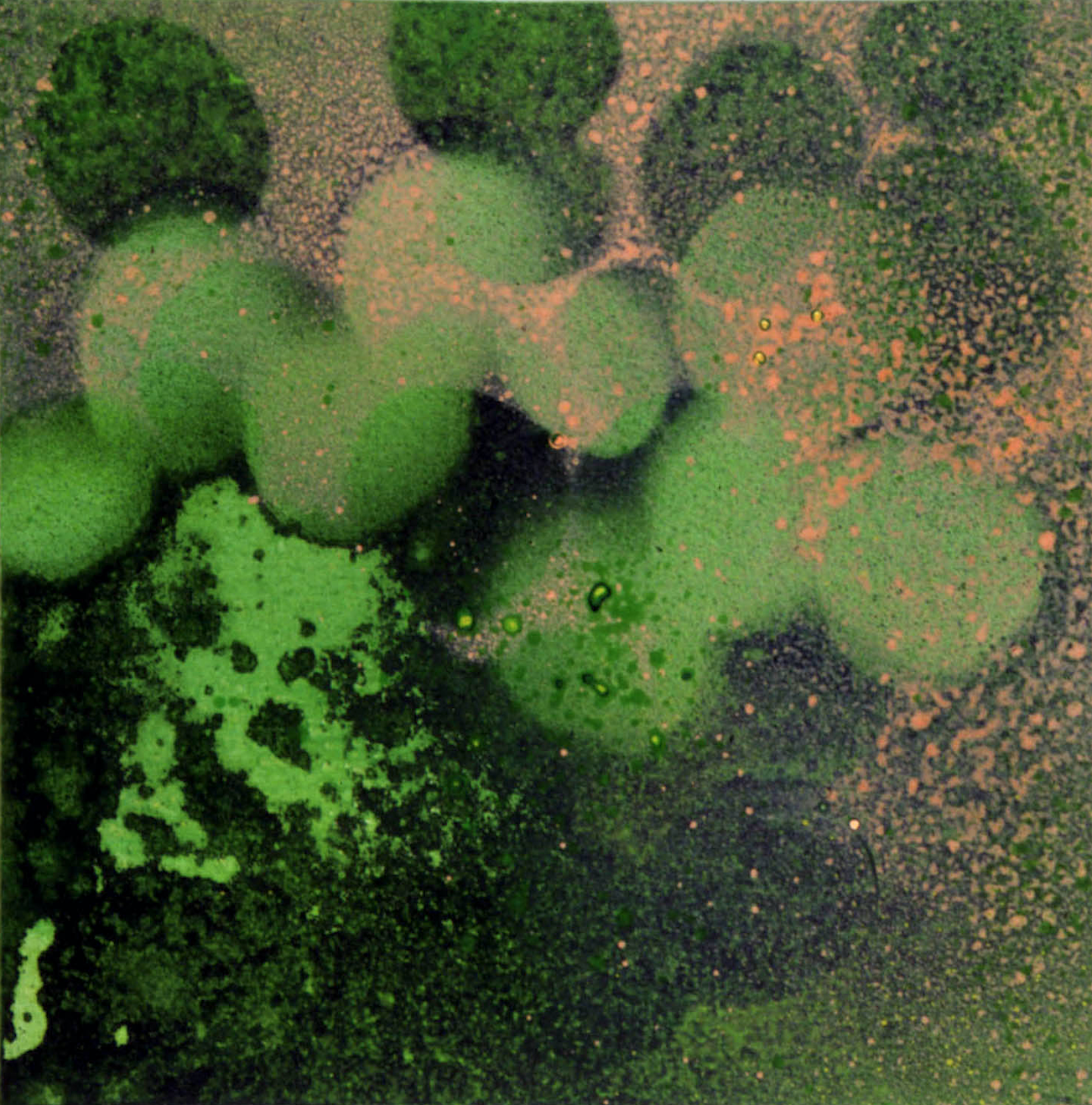
I started with three paintings using bold color. Red. Then Green. Then Yellow.
So, it turned out that Ross did hate my assemblage/“painting/pita-glued to canvas” process and products that I dared to call paintings. For Ross, a painting was made of paint. He made a simple suggestion: use the pita bread as a tool and not as an object. That made all the difference.
Here I also used a squeeze bottle and outlined around the pieces of pita as well as a rubber stamp(24″x24″)
I began to use the pita bread as a stencil — placing them on the flat canvas and then splattering, spraying and pouring paint around them. I diluted the paint with water and medium and used a sprayer or, like our ancestors in their caves, blew the paint on the canvas from a straw.
Adding dots made with the end of a brush and little starbursts (24″x24″)
Another friend begins to appear: The Drip (24″x24″)Here, I committed something of a painting mortal sin: mixing acrylic with oil paint. The end result didn’t explode. (24″x24″)(24″x24″)
I loved teaching. For many years, I was blessed to be in a trusted place to mentor young men, help them discover and develop their talents — and to grow to appreciate and value themselves. Three times in my life as an artist I have been blessed with men who have done that same thing for me. The first was Franklyn in Los Angeles. The second was my thesis director at Pratt, Ross Neher.
I first met Ross when I took his Drawing Seminar in my first semester at Pratt — life drawing from a model twice a week. Ross would position the model in her/his pose and we would begin to draw. He sat back and read the Wall Street Journal. A couple of times during the class, Ross would walk around and comment on our work. He was honest and direct. He was not warm and fuzzy.
Ross Neher
That same semester I took a painting class from a very kind and gentle man named Jerry Hayes. One day, Jerry came by my studio to see what I was working on. I was still playing with pita bread and gluing wire and other objects to canvases. I was completely lost and uncertain of what I was doing. And, as ever, wondering what I was doing trying to get an M.F.A. Jerry examined one of the pita-bread painting/assemblages that I’d brought from Los Angeles. He asked me, “Do you know Ross Neher?” I said I did, that I was taking him for a drawing course that semester. “Has he seen your work?” I said that no, he hadn’t. Jerry then assured me, “Well, he’d really hate it.”
Well, I wanted to find out what Ross really would think so I asked him to come by my studio. And Jerry was right: Ross really hated what I was doing with my painting/assemblages with pita bread, paint can lids and sticks. His response was not ambiguous.
One of the good things about being 40 rather than 20 beginning graduate school was that over the years I had accumulated enough bruises and scars to my ego that I could (not easily, mind you) accept criticism. I sensed that Ross was a man of substance and integrity — and that his opinion mattered. That he had something to say. So I asked him to explain his response. In fact, I would eventually ask him to be my Thesis director.
As I would come to learn, Ross was something of a purist when it came to painting. A painting should be made out of paint. Collage, assemblage, new forms etc., etc. — they might all be something and might have their own value as art in their own way (I doubt that Ross believed that) — but of one thing Ross was certain: they are not painting. If I wanted to be a painter, in his eyes, I should use paint. Period.
I came to respect his integrity and clarity. I began to appreciate that Ross was honoring a tradition that dated back centuries. A tradition that was under assault by all sort of new technologies and new forms — and by the popular notion that “painting was dead.” For Ross, it wasn’t. It was a discipline that demanded respect. And that respect is what Ross demanded of me…when he advised me of how much he hated what I had been doing with paint, pita bread, glue, wires and all sorts of other extraneous objects.
But there was something more: in his honesty and directness, he was taking me seriously as a painter. And calling me to do something more serious. To be something more serious. And he knew, I think, that as a Jesuit priest, I knew something about the value and values of a tradition. Consciously or unconsciously, he was challenging me.
I am grateful I was able to accept the challenge. And learn. Even in my 40’s.
I don’t cry easily. That doesn’t mean I’m not emotional. Just that I’m Irish. The drive across country was a wonderful experience. I enjoy solitude — and Interstate 70 offered me miles upon miles of it. As each mile receded behind me, I was leaving a well formed and comfortable image of Tom O’Neill. “Fr. Tom”: every 17 year old boy’s favorite Jesuit at Loyola High. It was true. And it was killing me.
Something new awaited me in New York. I wasn’t afraid of being on the other side of the desk again. School was something I knew how to do. But…
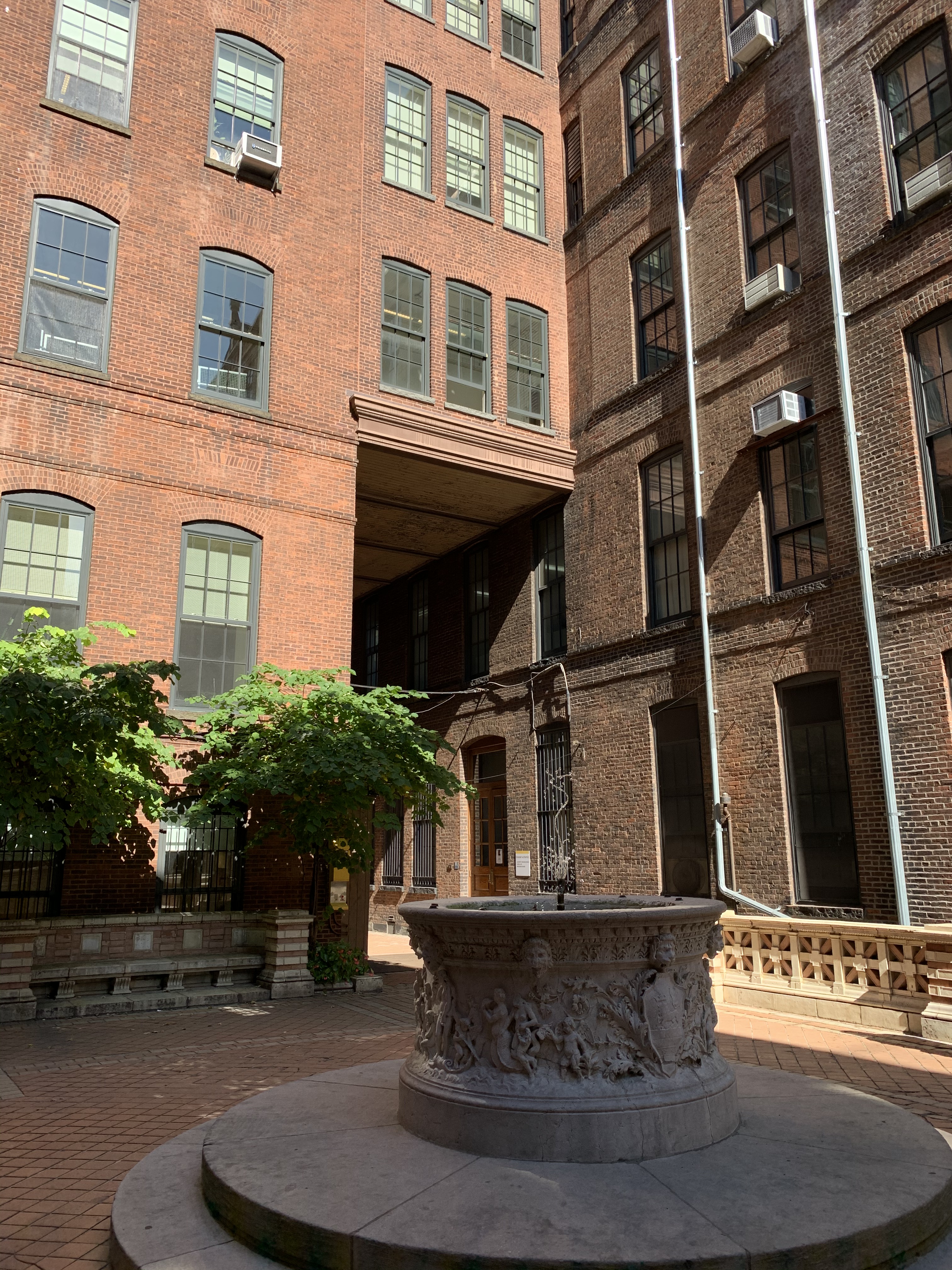
When I got to Pratt I was assigned a studio space in Steuben Hall. It turned out to be a large cubicle formed by four freshly painted white walls. The floor was covered and splattered with several years of paint. The traces of previous painter-pilgrims who had passed through the same halls and walls.
I began to unpack boxes of paint and supplies. Carried up several blank canvases that would soon be…well, something. But I had no idea what, just yet. Then I stopped and looked around. And broke into tears.
What was a doing here? I had no business being here. I was a fraud. It didn’t help that pretty much everyone who I met in my first days at Pratt were in their 20’s and full of energy, confidence and ready to take on the world. They were also freshly out of their undergraduate Fine Art programs and were well groomed and well honed in the latest verbiage and jargon of the art world. They were the gnostics who spoke a language of art in the new 21st Century — a language that was a mystery to me.
I was twice their age. I was teaching kids like them just two years ago. Put me behind a podium in front of 30 sophomores, and I’m an expert. A star.
Put me alone in my studio in Brooklyn. I’m a mess. And my tears confirmed it.
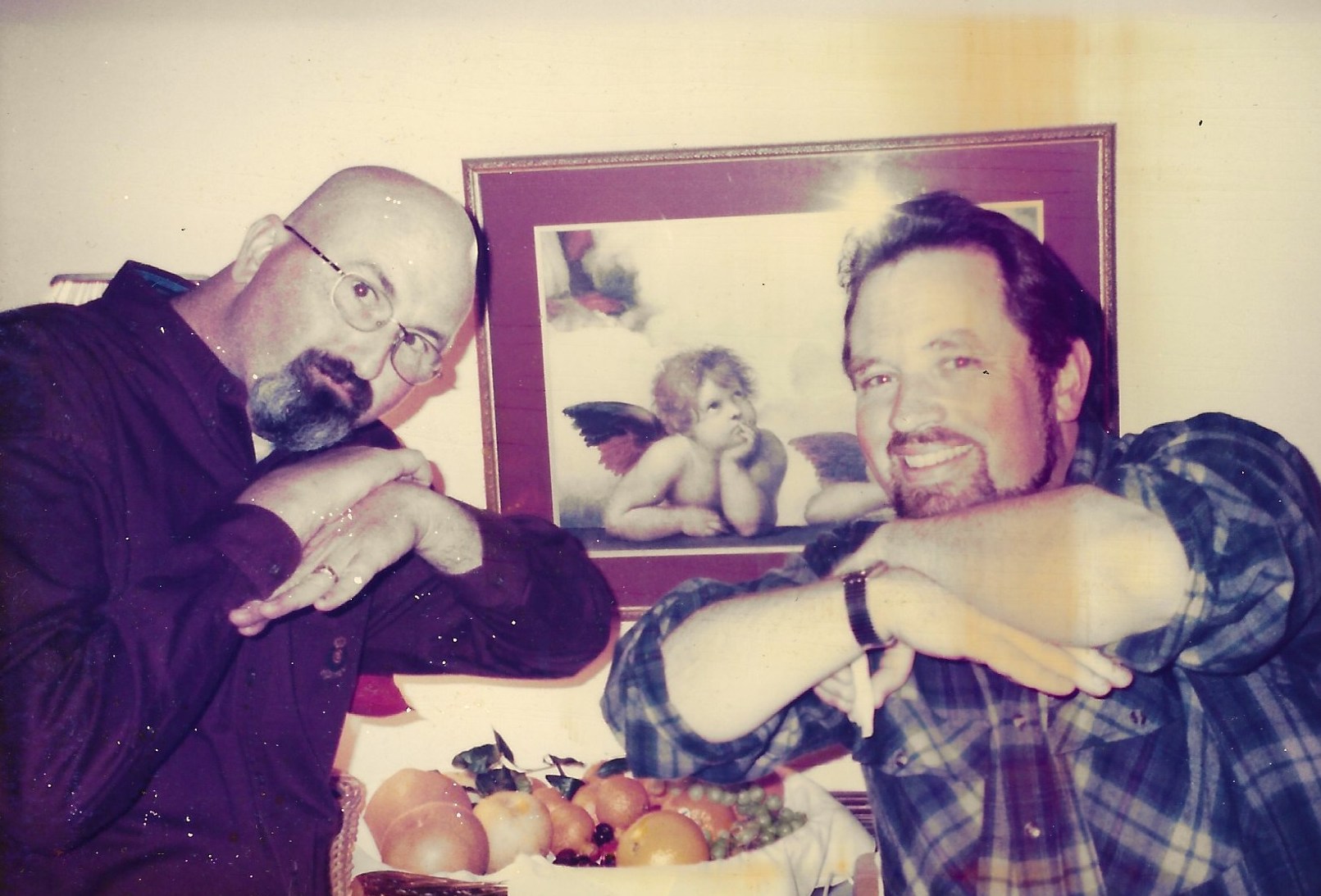
It was my friend Tom McCormick who urged me to pursue an M.F.A. in painting. Tom was always the loving guardian angel on my shoulder, seeing my gifts, encouraging my dreams and loving me as I was. And am. Here is a photo taken at the good-bye party given my by friends when I left Loyola High to begin the pilgrimage to Brooklyn. It’s my favorite photo of Tom and Tom.
My beard is now getting white too. There are worse people to become. Tom went home to God way too soon. I miss him deeply.
Sometime in August of 2000, I packed up my life in a UHaul truck and headed east. Rather than ship things to New York, I decided to drive. I always wanted to drive across the US, and this was a chance to do so. But even more, this move was not just a move, it was a deeply felt step on a pilgrimage. I emphatically needed to see Loyola High School in the rear view mirror. Not because I didn’t love my time there. In fact, just the opposite — I loved it too much. Or too small a part of me loved it too much.
The M.F.A. was not about adding initials to my pedigree, but about allowing hidden and neglected parts of me, of my soul, to step out into the light. How that was going to happen, I wasn’t sure about. But in order for that to happen, I had to say good-bye to 1901 Venice Boulevard and Rooms 313 and 901. AMDG.
My UHaul truck that carried me safe and sound from Los Angeles to New York (via my brother Joe’s home in Maryland.)
So, after spending a year taking classes at Art Center in Pasadena, Otis College of Art and Design in L.A. and a couple of classes at U.C.L.A. extension, I had built up enough of a portfolio to apply to M.F.A. programs. I had no idea what I was doing — so I picked programs in cities that I thought it would be fun to live in.
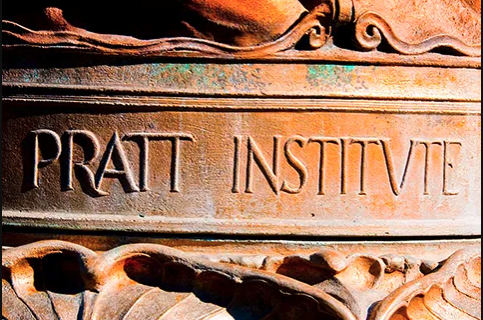
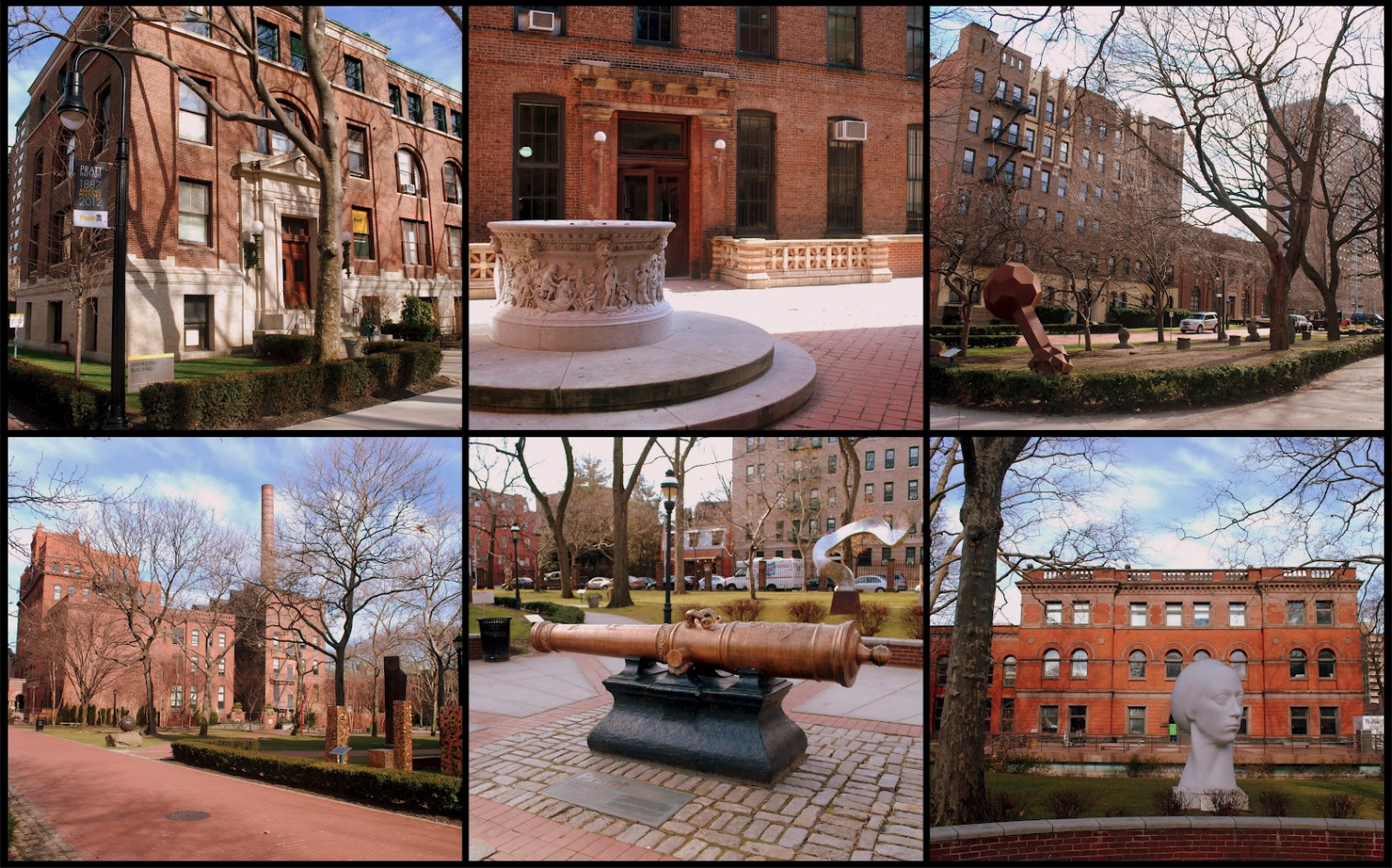
Entrance to Pratt Institute, Brooklyn, New York
On March 11, 2000, my 44th birthday, I received 8 rejection letters in the same mail delivery. Ouch. For over 10 years, as every boys’ favorite priest at Loyola High, I had counseled and consoled many a young man that his rejection from Stanford or Yale or whatever was simply part of God’s plan and that he would end up where God wanted him in the end.
Well, rejection sucks. So figured that graduate work in Fine Art just wasn’t part of the plan. Until the first week of May. One morning, a large manila envelop appeared in my mailbox: “Congratulations…” Not only was I accepted into an M.F.A. program, but it was to be in the greatest city on earth. New York.
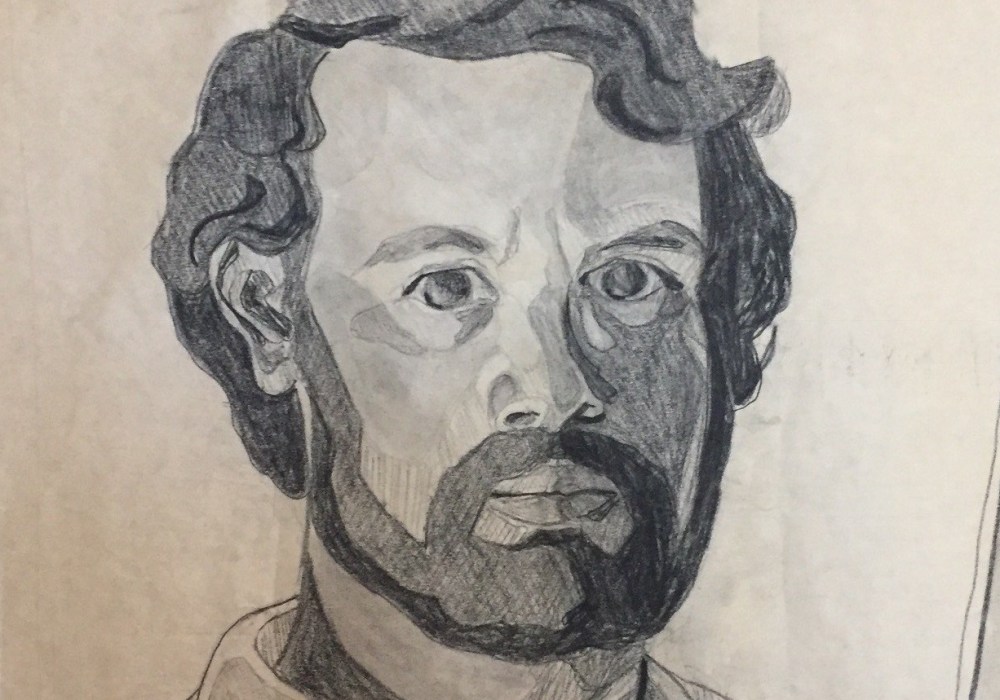
A little drawing a made while visiting my brother Joe in Maryland many years ago. Joe and Walt had two beautiful geriatric Golden Retrievers — Chassidy and Polar Bear. Chassidy was a bit neurotic but Bear was all gentleness and peace: the closest thing to heaven on earth.
One day as I was writing/sketching in my journal, I glanced over at Bear and did this quick drawing. A moment of inspiration for me. The usual for him.
Once again, I’m returning after a long hiatus. Here is some work from hither and yon.
A drawing for a friend
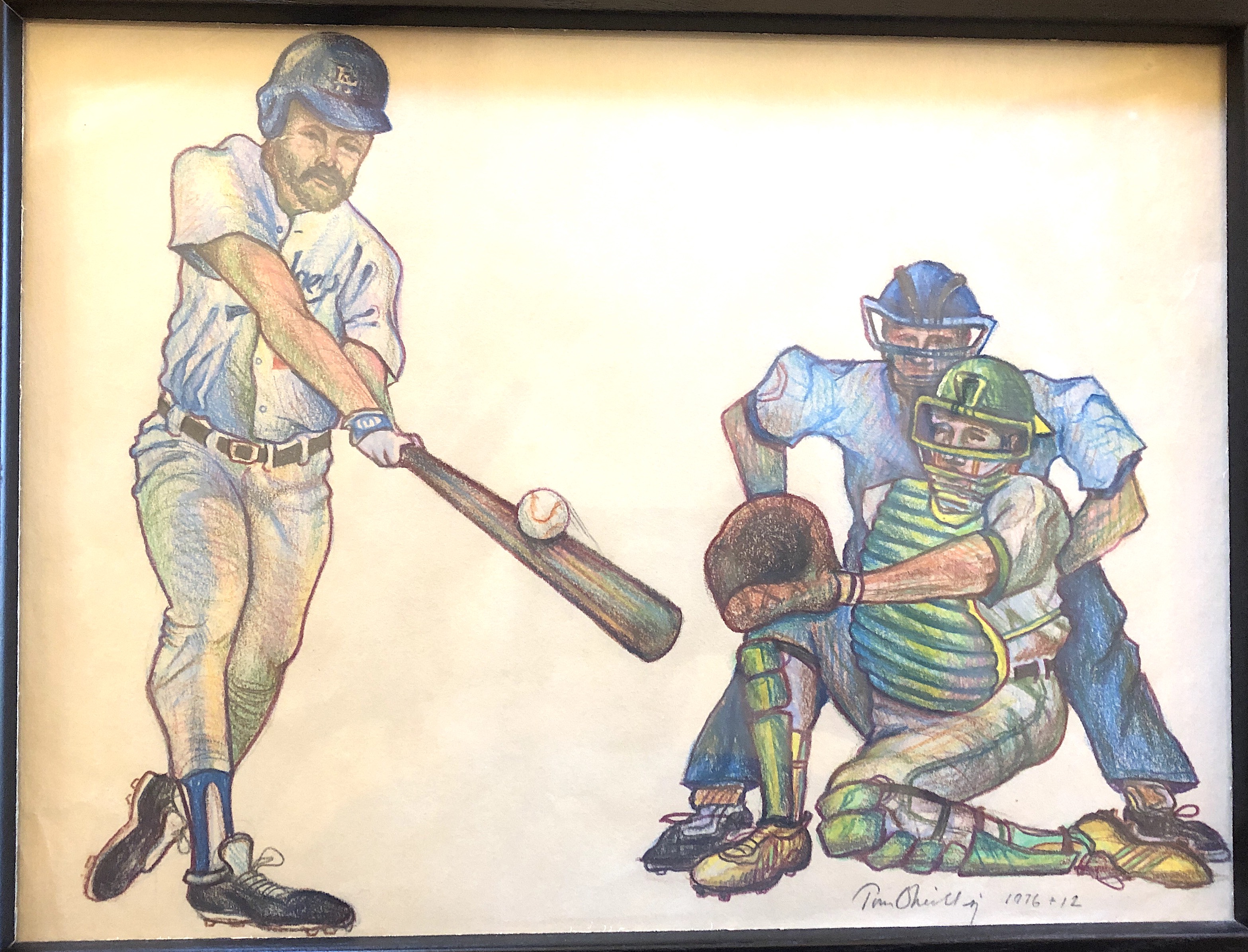
My best friend since the day I entered the Society of Jesus was Mark Toohey. He died way too young of a brain tumor. Mark was an avid Dodgers fan. I was — and am — a Giants fan. In 1988, the Dodgers won the World Series. The most memorable moment of that series was the heroic home run hit by Krik Gibson. As a gift to Mark, I did this drawing for him.The quality of this image isn’t great. It’s a photo of the drawing that Mark’s brother sent to me. The date on the drawing is 1976 (our entrance date into the Jesuits) + 12 years.
This is proof that I can actually stay within the lines if I need to.
Another painting that I gave Mark: one of the series I had done reflecting on Genesis One. Since Mark’s death in 1999, it has found a home of Jane and Jim McNaught in San Juan Capistrano. Jane is Mark’s sister. She was kind enough to send me a photo of my painting.
Heaven. Hi, Mark!
Two multi-media assemblages
Working with Franklyn, I did some multi-media work. Here are two of my favorites.
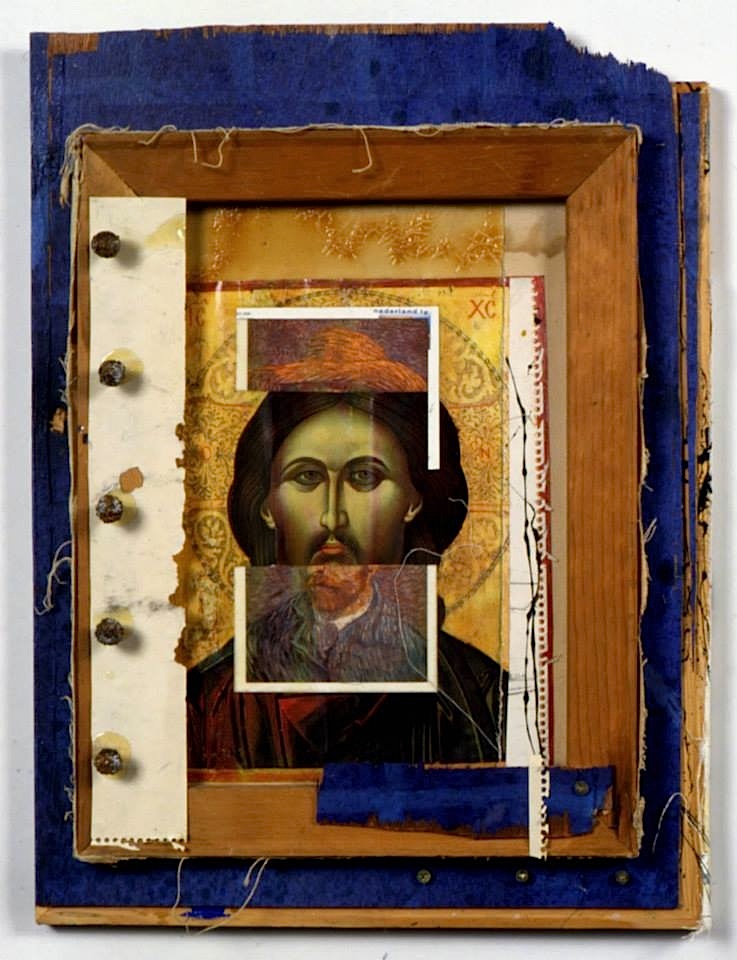
For Vincent, 1999
Vincent Van Gogh has become something of a patron saint for me. One of my earliest introductions to serious art was when I was able to see a major collection of his work in 1970. The Van Gogh Museum was being constructed in Amsterdam and the main corpus of his work was sent on a world tour. The De Young Museum was one of the places to exhibit this “once in a lifetime” show.
I remember standing in line with hundreds of others to catch a glimpse of Vincent’s work — 14 year old me trying to look over the shoulders of bigger people to see his Sunflowers, landscapes and empty old shoes. Then my mom read a brief notice in a local neighborhood newspaper that the exhibition was being held over one extra day. I went back. And the museum was almost empty. Just me and Vincent — and a few other souls. I think that day Vincent began to speak to my soul:
He wanted to serve God from the pulpit. But he found his voice, mission and salvation in paint. While I’ve not lost the pulpit in my life, in my best moments — and most healthy and grounded, it’s paint that is usually there too.
This image is made up of several significant elements:
an icon of Jesus
a postcard of Vincent, with had and red beard
the cut out border of another postcard with a small piece of a stamp from the Netherlands (a card sent to me by a close friend)
an old stretched canvas; ragged and stained, I turned it over to use not its surface but its hidden interior
two pieces of old undergraduate drawings
three pieces of the set of Loyola High’s Midsummer Night’s Dream painted with high luster deep blue stage paint
5 Eucalyptus acorns (Franklyn always told us to use odd numbers when adding elements) These acorns are from a tree in Golden Gate Park — the very tree that I stood under in 1970 waiting to get into the Van Gogh exhibition
liquid varnish poured onto the icon/old canvas
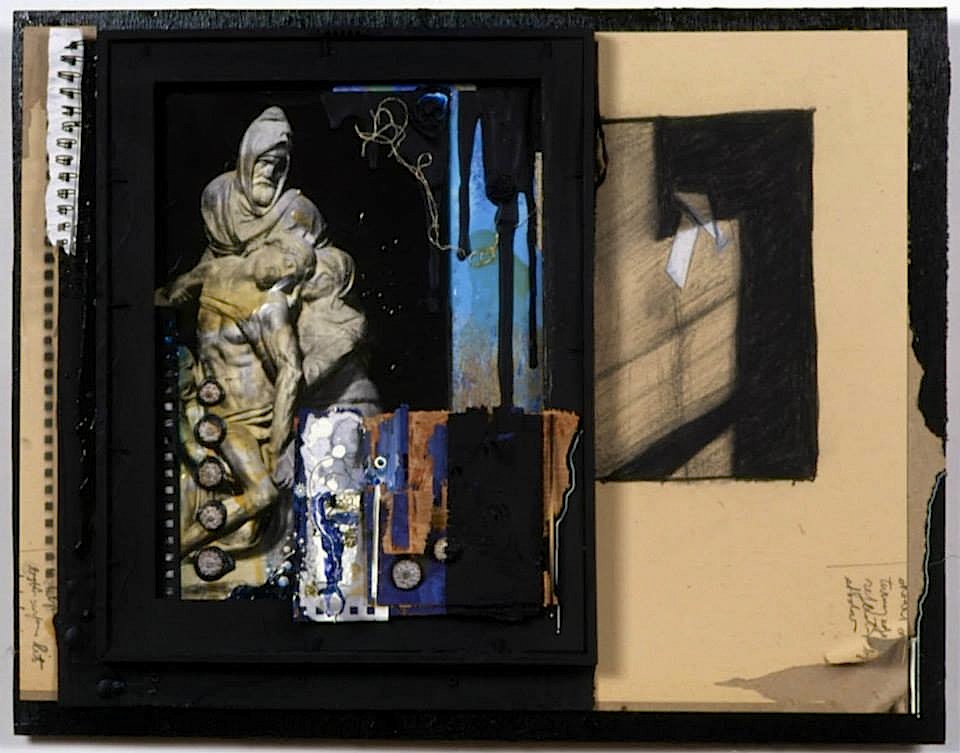
Tribute to Michelangelo, 1999
Another assemblage with significant elements:
a charcoal drawing of a street from a summer course at the California College of Arts and Crafts in Oakland sometime in the 1980’s
another old canvas turned upside down and painted with black gesso
the back of a piece of canvas board painted with light blue, with black gesso drips
another piece of the set from Midsummer Nights Dream
old tube of blue oil paint
torn page of old journal
wire spine of journal with single page attached
edge of back cover of journal painted with black gesso
five Eucalyptus acorns attached with black caulking material
photo of Michelangelo’s Deposition from the Cross/Pieta from Florence
poured liquid varish
The image of Michelangelo’s sculpture is something that I purchased in Florence when I went to Europe for the first time in 1974. I was transfixed by this work of art. I lost all track of time and discovered that I had been in front of it for over an hour. That is when I discovered the power of art. The image is one that I treasured. Every place I ever lived, from San Francisco, to Davis, to the Novitiate, LMU, Fordham and Loyola High — it was the very first thing I put on the wall. In 1988, I gave it to Mark Toohey as a Christmas present.
In 1999, after Mark’s death, his brother Rick was sorting through his belongings. He asked me if I knew anything about the photo. I claimed it. But I could no longer just hang it on the wall. It meant something new now. So I baptized it with paint, gesso, varnish and eucalyptus acorns.
A painting that I didn’t screw up
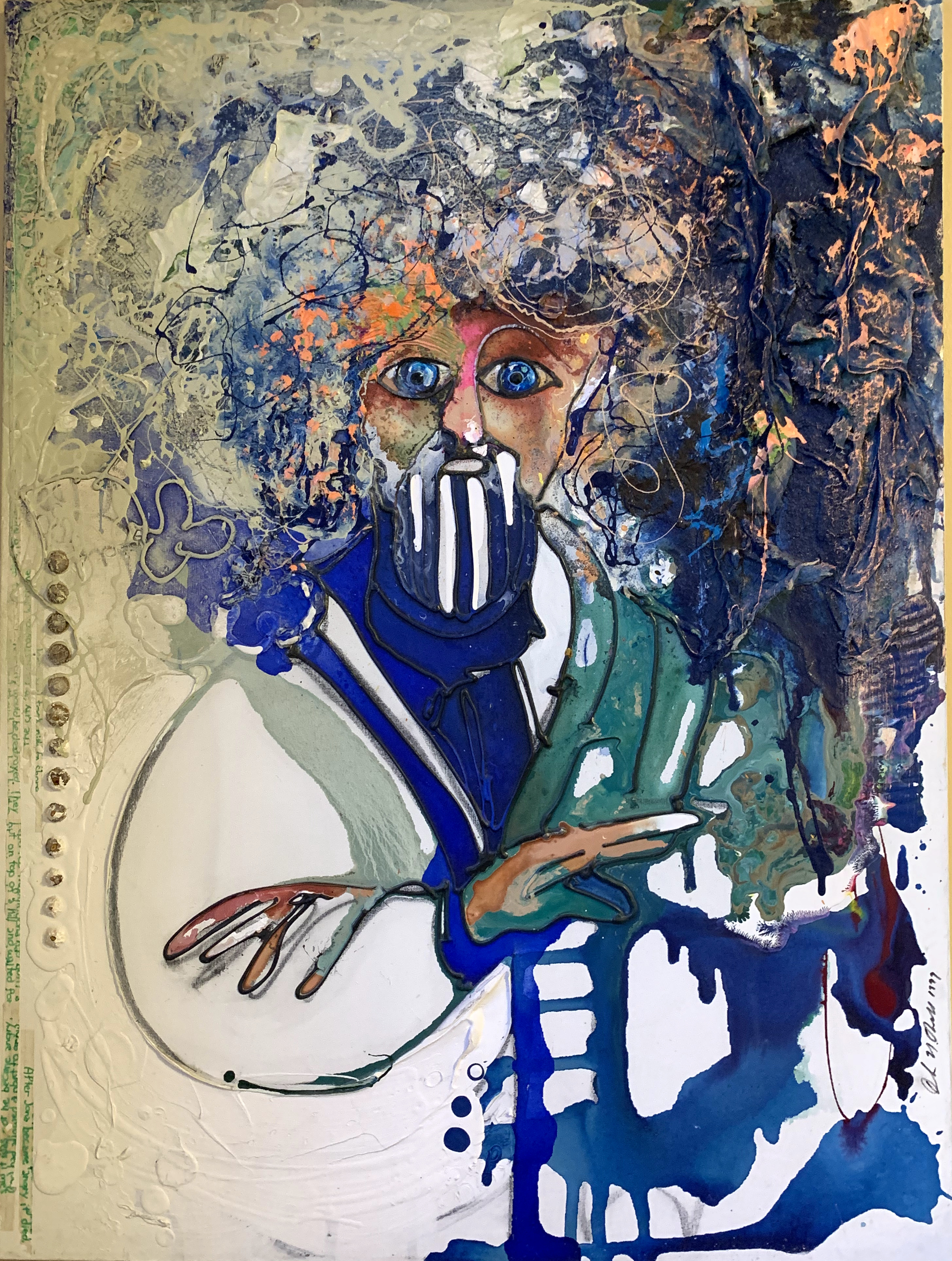
A Prophet, 1999A Prophet (detail), 1999
Loosely based on the Book of Kells, I used black caulk to outline the basic figure then starting pouring liquid acrylic paint onto the canvas while it was flat on some sawhorses. Added a couple of pieces of cheesecloth that were saturated with paint, some gel medium and lots and lots of gesso. Always lots of gesso. Did some detail work on the eyes.
A Prophet (detail), 1999
This is a large painting. And a success. Mainly because I stopped before I f***ed it up by overworking it. Which I usually do when left to my own devices. Let go. I’m still learning.





















 tommyosj